DUBAI,— Canada’s flagship agency overseeing major investment projects has informed United Arab Emirates officials that it does not currently have any projects prepared to take on the billions of dollars Abu Dhabi is prepared to invest, the Financial Times reported.
Three people familiar with the matter, who spoke on condition they not be named, said the Calgary-based Major Projects Office told a visiting UAE delegation in mid-June that it was too early to place capital into Canada.
One Canadian official noted that Carney continues to reference the C$70 billion (US$49 billion) commitment from the UAE that he secured during his first visit in November, even though none of that money has actually been put to use so far.
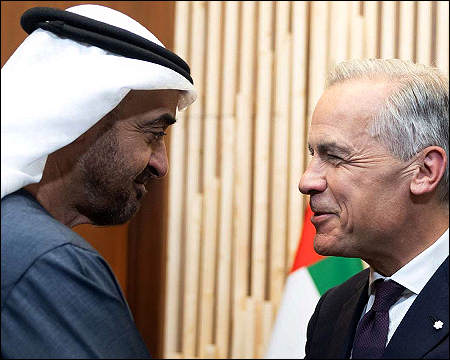
Prime Minister Mark Carney secured a US$50 billion pledge from UAE President Sheikh Mohamed bin Zayed al-Nahyan and Abu Dhabi Crown Prince Sheikh Khaled bin Mohamed bin Zayed al-Nahyan, who announced the commitment in November.
Abu Dhabi, rich in oil wealth, oversees close to $2 trillion in sovereign funds.
After Carney hosted a UAE-Canada Business Council meeting in Ottawa in mid-June, the Major Projects Office turned down Emirati delegation members seeking investment openings, the officials said, citing a shortage of projects far enough along to receive funding.
Jean Charest, former premier of Quebec and co-chair of the council, said the office was “only one bucket of potential projects.”
Charest explained that the response given to the delegation, essentially that Canada was not yet in a position to move forward, was the same message being given to every other prospective investor at this stage, not one aimed specifically at the UAE.
Despite the setback, Charest said Carney was shifting perceptions that Canada “was extremely difficult to get big projects done.”
Carney faces growing pressure to present “shovel-ready” projects at a Toronto investor summit in September, an event meant to draw $1 trillion in investment over five years.
An official from the UAE said the investments being discussed are subject to the usual steps that foreign capital typically goes through, noting that assessing opportunities and drawing up plans is a process that inevitably takes time before any deal advances.
The official said cooperation with Canada continues at every level, spanning federal and provincial governments as well as the private sector, and described the relationship between the two countries as among the most significant partnerships anywhere in the world.
Since taking office in March last year, Carney has promised to double trade with partners outside the United States and turn Canada into the “strongest” economy in the Group of Seven.
Roughly a year ago, he launched the Major Projects Office to speed along more than 20 projects worth a combined $135 billion.
The UAE remains central to Carney’s push to diversify investment, though projects under discussion are still awaiting regulatory approval, legal review, consultation and financing.
Carney has also directed staff to complete a UAE-Canada trade deal expected to be signed this month.
While visiting the UAE in November, he said a critical minerals agreement worth “over $1 billion” was close to finalized. Nine months on, it has not been completed.
Neither Canada’s Privy Council Office nor the Major Projects Office offered a reply when asked to comment.
A representative for International Trade Minister Maninder Sidhu affirmed that the relationship between Canada and the UAE is strong and continuing to expand.
On Thursday, Carney unveiled projects he said would “catalyse well over C$200 billion (US$141 billion) in new direct investments,” including a proposed pipeline carrying 1 million barrels of oil daily from Alberta to British Columbia’s coast.
Asked about the lack of private-sector backing for the pipeline, Alberta Premier Danielle Smith said investors remain cautious after three earlier proposals failed.
“We have pipeline companies that have literally spent billions of dollars in recent years on failed regulatory approval processes. That’s the environment we’re finding ourselves in. And so it does take some work,” she said.
Charest said the UAE delegation had shown interest in the pipeline and Canada’s energy sector broadly. “These are things that they know, that they’re familiar with,” he said.
Trade tensions with President Donald Trump have hurt Canada’s economy, which also faces regulatory red tape and trade barriers between provinces.
The Canadian Association of Petroleum Producers has called for policy changes aligned with the U.S. to attract foreign investment. CAPP president Lisa Baiton wrote in a May submission that Canada needs a competitive tax system, predictable regulation and expanded export infrastructure.
The Major Projects Office is also fast-tracking a container terminal at the Port of Montreal, which Dubai-based DP World plans to build by 2030.
Joel Werner, DP World’s chief operating officer in Canada, said the company aims to secure investment by early 2027, calling the terminal “a global priority inside DP World.”
Royal Bank of Canada CEO David McKay said in June that after a decade of being turned away, the private sector is now waiting for government and other stakeholders to align.
He said he can see that progress happening firsthand and that the bank is backing it.
Charest said how Ottawa would meet all of Canada’s priorities remained “a very good question.”
(With files from The Financial Times)
Copyright © 2026 Dubai Diplomacy. All rights reserved.
 Your support matters! Consider buying us a coffee — every bit helps keep independent news alive.
Related posts:
 UAE speeds up oil pipeline project to bypass Hormuz
 UAE eyes $50 billion in Canadian AI and energy industries
 UAE-Syria trade doubles in 2025, poised for growth: minister
 UAE completes 50% of Hormuz bypass oil pipeline ahead of 2027 launch: ADNOC
 UAE ports key to Gulf trade lifeline
 UAE pushes for “zero” dependency on Strait of Hormuz
 Abu Dhabi crown prince Sheikh Khaled readies for UAE power
 UAE, South Korea sign $35 billion defense cooperation MOU