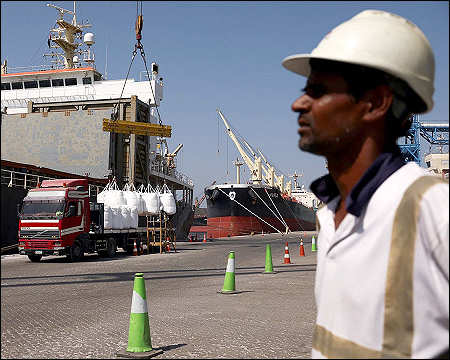
DUBAI,— At the UAE port of Fujairah, conveyor belts on Wednesday unloaded grain from bulk carriers while crude oil moved through pipelines into tankers docked along the quay, Reuters reported.
Trucks carrying cargo lined up outside the port waiting for entry, while offshore vessels from Cosco, Gardenia and other shipping lines remained anchored with service boats moving between them.
Fujairah and Khor Fakkan, both on the UAE’s eastern coast with access to the Indian Ocean, have become critical trade gateways after the effective closure of the Strait of Hormuz disrupted shipping routes through the Gulf.
The two ports now handle most of the country’s seaborne trade, replacing major western Gulf terminals where vessel traffic has been stranded.
Since the start of the Iran war, crude exports through Fujairah have increased by 38%, pushing the flow toward the upper capacity of the pipeline that feeds the port.
At Khor Fakkan, operator Gulftainer said container volumes have increased about 25-fold over the same period.
The shift underscores how quickly regional trade routes have changed as tensions escalated in the Gulf.
Iran on Monday demonstrated the vulnerability of the UAE’s eastern ports when drones struck the Fujairah Oil Industry Zone, sparking a fire at a key energy facility and injuring three workers.
Hours earlier, Iran’s Revolutionary Guards Navy released a map showing an expanded operational zone along the UAE’s eastern coastline that included both Fujairah and Khor Fakkan.
Shipping sources said port operations were not immediately affected, but the message from Tehran was widely viewed as a warning.
The UAE foreign ministry referred comment to federal and Fujairah authorities, Abu Dhabi National Oil Company, and state news agency WAM.
Officials have repeatedly said freedom of navigation through the Strait of Hormuz remains a priority and that the UAE reserves the right to respond to any attacks on its territory.
Energy Minister Suhail Al Mazrouei said last month at a logistics forum in St. Petersburg that no country has the right to disrupt international trade flows or threaten global supply routes.
Fujairah is positioned at the end of the Abu Dhabi Crude Oil Pipeline, which can transport between 1.5 million and 1.8 million barrels per day from inland fields to the Gulf of Oman, bypassing the Strait of Hormuz entirely.
This allows the UAE’s state oil company ADNOC to maintain exports despite Gulf disruptions.
Kpler analyst Johannes Rauball said crude exports from Fujairah rose to an average of 1.62 million barrels per day by late March, up from 1.17 million in February.
Data from Kpler also shows the port has begun receiving container vessels regularly since the conflict began.
Khor Fakkan has experienced even sharper growth. Gulftainer said weekly container handling has risen to 50,000 units from about 2,000 before the war. Vessel traffic has nearly quadrupled, according to Kpler data.
Chief executive Farid Belbouab described Khor Fakkan as a critical national gateway that now handles imports ranging from food supplies to medical goods.
Truck traffic reflects the surge. Belbouab said daily truck movements increased from about 100 before the conflict to roughly 7,000 now, and the company hired about 900 workers in two weeks at the start of the war.
Shipping data shows continued heavy activity. Six container ships were berthed at Khor Fakkan with 10 waiting, while Fujairah had two berthed and one waiting.
Logistics company GEODIS said operations remain stable but congestion has increased, noting the ports are currently the only direct UAE maritime entry points avoiding longer overland routes through Saudi Arabia or Oman.
Regional geography continues to shape trade resilience. Saudi Arabia’s East-West Pipeline has maintained flows of about 7 million barrels per day via Yanbu, bypassing Hormuz, although earlier in the year Iran struck both pipeline and port infrastructure.
For Gulf states such as Qatar, Kuwait and Bahrain, reliance on Strait of Hormuz shipping remains a challenge, increasing dependence on UAE ports or costly overland transport routes.
Gulftainer is planning a dry port and logistics hub in Al Dhaid, about 50 kilometers from Khor Fakkan, covering more than 100 hectares with a cost exceeding $100 million in its first phase. The facility will connect by road and rail.
Despite continued operations, officials and operators acknowledge uncertainty following repeated strikes on regional energy infrastructure, including a March 14 drone attack on Fujairah that disrupted oil loading operations.
Belbouab said he cannot predict when maritime conditions in the region will stabilize but said alternative regional transport routes may provide backup options if needed.
(With files from Reuters)
Copyright © 2026 Dubai Diplomacy. All rights reserved.
 Your support matters! Consider buying us a coffee — every bit helps keep independent news alive.
Related posts:
 UAE’s Fujairah halts some oil loading after Iran drone attack
 Dubai oil benchmark under stress amid Iran war
 UAE’s Fujairah port sees bunkering slowdown after fire
 Iran launches missile and drone strikes at UAE, ministry says
 The Strait of Hormuz will be closed as soon as the U.S. navy leaves
 Gulf states say ending Iran war not enough, degrade its capabilities
 Dubai’s Jebel Ali port fully operational, vessel flow slows
 UAE urges guaranteed access to Strait of Hormuz in US-Iran deal