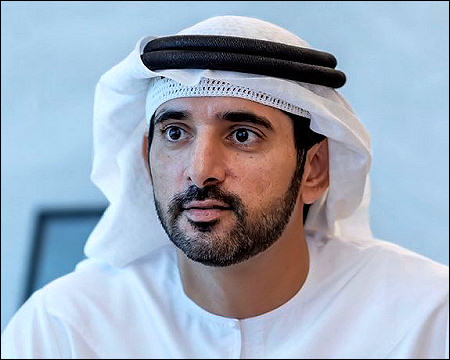
WASHINGTON,— Maria was certain she had met her match. Night after night, a handsome royal from Dubai appeared on her phone, sending poems, promising his love and calling her his “beloved.” He was not real.
The figure on her screen was a computer-generated forgery. Maria, a domestic worker from the Philippines who asked that her full name not be published, lost more than a year’s wages in a scheme that AFP traced to fraudsters impersonating Sheikh Hamdan bin Mohammed bin Rashid Al Maktoum, the crown prince of Dubai.
Known by the pen name Fazza, the prince commands more than 17 million followers on Instagram, giving criminals an enormous library of images, videos and poetry to use against unsuspecting victims.
Researchers have connected some of these operations to criminal networks in Nigeria, AFP said.
Maria’s ordeal began on a dating website, where a person claiming to be the prince made first contact.
The exchange shifted to a messaging app, and the flood of romantic messages that followed showed no sign of stopping.
“He kept on messaging me even when I was sleeping,” she told AFP. “It felt like there was a love spell that connected our minds.”
AFP reviewed a WhatsApp video call in which the scammer, using an AI-generated face resembling the prince, appeared on screen.
The lips moved in time with the words, but the voice was not Hamdan’s. “Hello beloved,” it said. “I really appreciate your love and support.”
Still convinced she was speaking to royalty, Maria transferred 100,000 pesos, about $1,625, for what the man described as a marriage certificate and a “royal membership card,” documents he said would guarantee her a position working in Dubai.
The deception began to unravel when the scammer demanded 60,000 more pesos, approximately $974, to cover a hotel room for a planned meeting.
Looking more carefully at his Facebook page, since deleted, Maria noticed the account had originated in Nigeria. She sent him a final message: “Go to hell, scammer.”
“Many people told me it’s good I didn’t go crazy after this experience,” she said.
Multiple Facebook groups impersonating the prince, some attracting thousands of followers, where posts directed users to private chats on WhatsApp and Telegram.
Among the images shared was one showing a man resembling Hamdan kneeling with a ring and another presenting a red rose. The caption on one post read: “Sweetheart can I get a ‘love you’ on WhatsApp?”
Some users posted warnings in the comments. Many more replied with hearts and blowing-kiss emojis.
The fraud has prompted pushback from those trying to fight it. An Instagram page called “Do not fall for fake prince” was created to reach potential victims.
A Change.org petition titled “Stop Fazza Scam” urged the prince’s staff to alert the public about impostors using Dubai phone numbers and demanding payment, at times in cryptocurrency, for items including forged marriage certificates.
“Significant payments are requested in banks in countries other than those of victims, sometimes even in cryptocurrencies, making it harder to trace,” the petition noted.
The prince’s case is not unique. In France, authorities last year began investigating a group of scammers who posed as Hollywood actor Brad Pitt and stole 830,000 euros, the equivalent of about $945,000, from a single victim.
Figures compiled by the Global Anti-Scam Alliance show that worldwide losses to scams, including romance fraud, reached $442 billion over the past year.
The specific AI tools used to produce the convincing live video calls with Maria were not identified.
A wide range of face-swapping and real-time motion-control applications is now accessible online, allowing users to alter facial expressions and movements with striking accuracy.
David Rand, a researcher at Cornell University, told AFP that the opportunity to address this problem is narrowing.
“The technology is improving rapidly, and it is likely that soon real-time video deepfakes will become better and better,” Rand said.
“Once this happens, it becomes fundamentally impossible to tell whether any not-in-person conversation is real.”
An expert told DubaiDiplomacy that those suspicious of a deepfake during a live video call to avoid simple tests such as asking someone to cover their face or turn their head, as current AI can often replicate those movements.
More effective, the expert said, is requesting a series of quick, unpredictable actions, such as touching different parts of the face in a specific order, turning the head in changing directions, or holding up a varying number of fingers.
The expert advised watching for delays, unnatural movement, or distortions around the hands, hair and facial edges when objects cross in front of the face.
If anything appears off, the call should be treated as unverified and the person’s identity confirmed through a separate channel before responding to any request.
(With files from AFP)
Copyright © 2026 Dubai Diplomacy. All rights reserved.
 Your support matters! Consider buying us a coffee — every bit helps keep independent news alive.
Related posts:
 Abu Dhabi royals robbed of £600,000 in jewellery in London
 Abu Dhabi crown prince Sheikh Khaled readies for UAE power
 Dubai rolls out 1 billion dirham economic support amid Iran war
 Is a Gulf NATO Really Possible?
 Dubai taps businesses to secure hub status after Iran war shock
 Ex-wife of Dubai prince loses custody, alleges police coercion, UAE
 Dubai Takes Your Money, Then Your Freedom: British family case
 Dubai Real Estate Lost 34%, The Worst Could Still Be Ahead