‘Up to 61.2% Off’: Dubai Luxury Real Estate Sees 3,056 Active Price Drops
DUBAI,— If you’ve been scrolling through luxury property listings lately, you may have stumbled upon a stark, almost clinical dashboard: columns of red numbers, percentage signs, and a live ticker showing exactly how much money millionaire sellers are leaving on the table.
The dashboard just updated, and the numbers are stark.
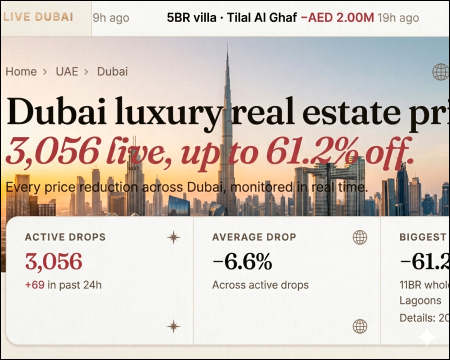
As of this morning, June 4, 2026, there are 3,056 active price drops across Dubai’s luxury property market. The average reduction is deep, but the headline figure is the ceiling: some sellers have slashed asking prices by as much as 61.2% .
Those figures come from LuxuryPriceDrops.com, a live tracker that monitors over 20,000 listings across the city. The website is not a brokerage. It is not a magazine. It is, essentially, a live heat map of seller motivation, and today, that map is glowing red.
Here is what those numbers actually mean for buyers, sellers, and the health of the Dubai market.
The ‘18% Rule’ and the Clock
First, look at the site’s methodology. They monitor every price reduction across neighborhoods like Palm Jumeirah, Emirates Hills, and Downtown Dubai.
One of the most telling data points isn’t just the size of the cut, it’s the timing. According to the site’s analysis, roughly 18% of luxury listings see a price reduction within their first 60 days on the market.
In practical terms, that’s the “honeymoon is over” indicator. In the first two weeks, a seller holds firm. By week six, if there are no offers, the psychology shifts. By day 60, the red number appears.
The ‘5% vs. 61.2%’ Threshold
Not all price drops are created equal. You need to look at the severity of the cut.
- The 5% Drop: The site notes this is routine. This is the “market adjustment” or the “I overpriced it by a few thousand dirhams.” It signals a negotiator, not a catastrophe.
- The 15%+ Drop: This is where it gets serious. The site explicitly calls this the “motivated seller” window. A 15% cut on a multi-million dirham villa isn’t a discount; it’s a distress signal.
But today’s data shows drops reaching 61.2% . That is not a negotiation. That is an exit. When you see cuts of 20%, 30%, or above 60%, you are no longer looking at a luxury home.
You are looking at a liability for the current owner. The data suggests this happens when sellers face relocation back to home countries, tax-residence shifts, end-of-year liquidity needs, or off-plan handover deadlines.
The Neighborhood Nuance
The figures also tell a story about location. You have to read the context of the numbers:
- Palm Jumeirah, Emirates Hills, and Downtown Dubai: High volume of large drops. Because the entry price is so high for 5,000 sqft+ villas and ultra-prime apartments, a 10% drop here wipes out millions in equity. The site suggests this is where “ultra-prime” owners take the biggest hits.
- Dubai Marina and JBR: Frequent, smaller drops. The data indicates this is “investor turnover.” These are often sellers offloading 1- and 2-bedroom luxury apartments, likely to free up cash for the next deal.
- Business Bay and DIFC: Tight drops. The tracker implies these areas are more stable. When a drop happens there, it is smaller but more frequent, a slow bleed rather than a crash.
The ‘Wiped’ Metric and Total Exposure
Perhaps the most aggressive figure on the dashboard is the “Total Wiped” metric. This is the cumulative sum of all reductions across the city.
With over 3,000 active drops and reductions reaching into the dozens of percentage points, that wiped total is substantial.
For every property that sells at asking price, there are dozens sitting in the “Active Drops” feed.
This indicates a market that is bifurcating: trophy assets at the very top may hold value, but the middle and lower tiers of luxury are facing a serious liquidity event.
What This Means for Dubai
These figures mean transparency. In many global markets, price cuts are whispered behind closed doors. Here, they are broadcast hourly.
For a Dubai buyer, a 10% drop on a AED 7 million apartment in Downtown is not necessarily a sign of a “bad building” according to this data, it is often a sign of a seller who just shifted their tax residence or a fund manager needing year-end liquidity.
But a 61.2% drop? That is a different animal entirely. That signals a seller who is not just motivated but desperate.
The tracker’s 45,000 “watching” users aren’t there for the architecture. They are there for the arithmetic. In Dubai’s luxury real estate market, a falling price isn’t always a warning, it’s often an invitation.
And with 3,056 active drops and discounts as steep as 61.2%, the invitation list today is very, very long.
(With files from LuxuryPriceDrop.com)
Copyright © 2026 Dubai Diplomacy. All rights reserved.
 Your support matters! Consider buying us a coffee — every bit helps keep independent news alive.
Related posts:
 Dubai Real Estate Lost 34%, The Worst Could Still Be Ahead
 Luxury carmakers’ profits in UAE, Gulf threatened by Iran war
 UAE property market faces test after Iran attacks; foreign buyers crucial
 Dubai property market shows early signs of cooling
 Dubai crude premium drops as sellers flood TotalEnergies
 Dubai ruler issues law on building quality and safety, UAE
 Dubai drops minimum property value requirement for 2-year visa: DLD
 Luxury brands shut UAE, Middle East stores amid Middle East conflict