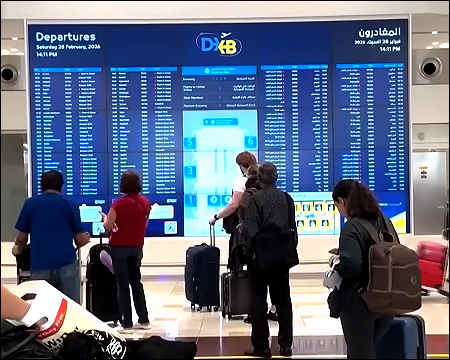
DUBAI,— The Strait of Hormuz has never belonged to Iran and cannot be closed or restricted by Tehran, Sultan Al Jaber, chief executive of Abu Dhabi National Oil Company, said Sunday on X.
Al Jaber stated that any disruption to traffic in the strategic waterway would extend beyond the region and affect the global economy.
He said such action would threaten energy supplies, food distribution, and health systems worldwide.
He added that this conduct would be illegal, dangerous, and unacceptable, and said the international community cannot allow it to happen.
US set to block Iran ports after talks collapse
Meanwhile, the United States military announced plans to begin a blockade of maritime traffic to and from Iranian ports starting Monday, after talks over the weekend failed to produce an agreement to end hostilities with Iran.
The breakdown in negotiations has placed a fragile ceasefire at risk.
The discussions took place in Islamabad from Saturday into early Sunday. They marked the first direct meeting between U.S. and Iranian officials in more than ten years and were the highest-level talks since Iran’s 1979 Islamic Revolution.
The negotiations followed a ceasefire that began Tuesday. The truce was intended to stop six weeks of fighting that has resulted in thousands of deaths across the Gulf region, disrupted energy supplies, and raised concerns about a broader conflict.
U.S. Central Command said the blockade would begin at 10 a.m. Eastern Time, or 1400 GMT, on Monday.
It said enforcement would apply equally to vessels from all nations entering or leaving Iranian ports and coastal areas, including locations along the Arabian Gulf and the Gulf of Oman.
The U.S. military added that ships traveling through the Strait of Hormuz to non-Iranian destinations would not be stopped.
It said further guidance would be issued to commercial shipping through official notices before the blockade takes effect.
President Donald Trump said Sunday that U.S. forces would also stop any vessel in international waters that had paid a toll to Iran.
He wrote on social media that ships making such payments would not have safe passage. He also warned that any Iranian forces firing at U.S. assets or civilian vessels would face severe retaliation.
Trump further said the U.S. Navy would begin clearing naval mines that Iran had placed in the Strait of Hormuz. The passage is considered a key route for about 20 percent of global energy supplies.
Shipping data showed that three large oil tankers passed through the strait on Saturday. However, by Monday, vessels were avoiding the area ahead of the planned blockade.
Oil markets reacted quickly. Benchmark crude prices rose more than 7 percent, surpassing 100 dollars per barrel during early trading in Asia.
The U.S. dollar strengthened, while U.S. stock futures declined after the announcement.
Dana Stroul, a former senior Pentagon official now with The Washington Institute for Near East Policy, said the plan may face challenges.
She said the operation would be difficult to carry out alone and could be hard to sustain over time.
(With files from Reuters)
Copyright © 2026 Dubai Diplomacy. All rights reserved.
 Your support matters! Consider buying us a coffee — every bit helps keep independent news alive.
Related posts:
 Strait of Hormuz closed, must reopen, UAE’s ADNOC CEO says
 UAE’s ADNOC CEO calls Iran curbs on Hormuz “economic terrorism”
 The Strait of Hormuz will be closed as soon as the U.S. navy leaves
 Iran says Strait of Hormuz is fully open during ceasefire
 UAE secretly slips oil tankers through Strait of Hormuz: Reuters
 Pressure grows on Dubai’s DP World over chief’s alleged Epstein ties
 UAE urges guaranteed access to Strait of Hormuz in US-Iran deal
 UAE ports key to Gulf trade lifeline