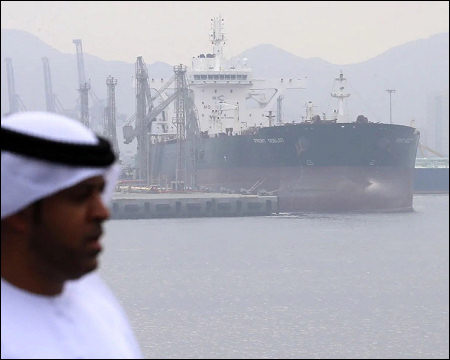
DUBAI,— Several tankers carrying crude oil from the United Arab Emirates and its buyers have moved through the Strait of Hormuz with location trackers turned off, a measure taken amid concerns over Iranian attacks, industry sources show, Reuters reported.
The shipments are part of an effort to clear crude that has been backed up in the Gulf due to conflict in the Middle East.
The volumes remain far below normal UAE export levels before the U.S. and Israeli military actions against Iran, but they reflect a willingness by producers and buyers to accept higher risk to maintain trade flows.
Other major Gulf exporters have adjusted operations. Iraq, Kuwait, and Qatar have either paused sales, reduced prices sharply to attract buyers, or shifted shipments through the Red Sea, in the case of Saudi Arabia.
In April, Abu Dhabi National Oil Company, ADNOC, exported at least 4 million barrels of Upper Zakum crude and 2 million barrels of Das crude on four tankers departing from terminals inside the Gulf, according to three industry sources, Kpler shiptracking data, analysis from SynMax.
According to Reuters the cargoes were moved using a combination of ship-to-ship transfers to vessels bound for Southeast Asia, storage discharge in Oman, or direct deliveries to South Korean refineries. This system of exports is being reported publicly for the first time.
Tehran responded to U.S. and Israeli strikes that began on February 28 by restricting passage through the Strait of Hormuz for all but its own exports, effectively bottling up about a fifth of global oil and gas supply.
The disruption, combined with a U.S. blockade that has curtailed Iranian exports, has pushed crude prices above 100 dollars per barrel.
Since the start of the conflict, ADNOC has reduced exports by more than 1 million barrels per day compared with 3.1 million barrels per day last year, according to Kpler data. Most remaining exports consist of Murban crude shipped via pipeline to Fujairah.
The shipments also carry security risks. Iran has accused the United Arab Emirates of attacks, including an allegation on Monday that Iranian drones struck an empty ADNOC tanker named Barakah passing through the strait.
To reduce detection risk, vessels have been sailing with automatic identification system transponders switched off.
The practice is widely used by Iran to evade sanctions on its own oil shipments, but it also complicates tracking of ADNOC exports, meaning actual volumes could be higher than recorded.
Kpler data shows that the VLCC Hafeet loaded 2 million barrels of Upper Zakum on April 7 inside the Gulf and exited the Strait of Hormuz on April 15.
Between April 17 and 18, the cargo was transferred outside the strait to the Greek flagged VLCC Olympic Luck, which then delivered the oil to the Pengerang refinery in Malaysia, a joint venture between Petronas and Saudi Aramco, according to Kpler and SynMax.
Hafeet is operated by ADNOC Logistics and Services, which declined to comment. Olympic Luck is managed by Greece based Olympic Shipping and Management, which also declined to respond. Petronas did not comment.
Ship to ship transfers allow ADNOC to split cargoes into smaller parcels and free up large tankers to return quickly to loading operations inside the Gulf.
One Upper Zakum cargo was delivered to a Northeast Asian refinery and sold at a premium of 20 dollars per barrel above ADNOC official selling prices, a source with direct knowledge said.
For Das crude, the VLCC Aliakmon I loaded 2 million barrels on April 27, exited the strait on May 2, and discharged at Oman Ras Markaz storage terminal on May 3, Kpler data shows.
Two Suezmax vessels, the Odessa and Zouzou N, each carrying 1 million barrels of Upper Zakum, also exited the strait and were headed to South Korea, according to Kpler and SynMax.
All three vessels are managed by Dynacom Tankers Management of Greece. It was not clear who chartered them. Dynacom did not respond to requests for comment.
ADNOC plans to continue exports through the Strait of Hormuz, notifying some customers in late April that they could load Das and Upper Zakum crude from May using ship to ship transfers outside the Gulf, including Fujairah and Sohar in Oman.
The company is also in discussions with Asian refiners for May loading cargoes, according to a source familiar with ADNOC plans and an Indian refining source who spoke on condition of anonymity.
(With files from Reuters)
Copyright © 2026 Dubai Diplomacy. All rights reserved.
 Your support matters! Consider buying us a coffee — every bit helps keep independent news alive.
Related posts:
 UAE ports key to Gulf trade lifeline
 Saudi-UAE rift widens as Emirates quits oil cartel
 Dubai oil benchmark under stress amid Iran war
 Subsea internet cables in Hormuz at risk amid Iran war
 ADNOC group companies report $9.7 billion net profit in 2025
 Iran says Strait of Hormuz is fully open during ceasefire
 Strait of Hormuz isn’t Iran’s to control, ADNOC CEO says
 Gulf states press Trump to continue war until Iran is fully weakened