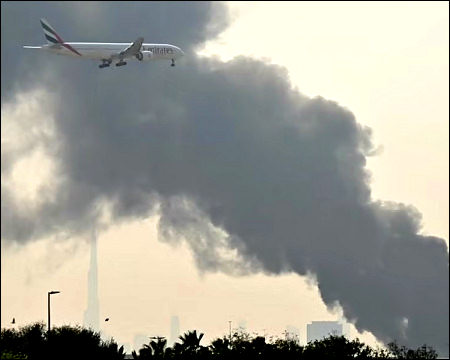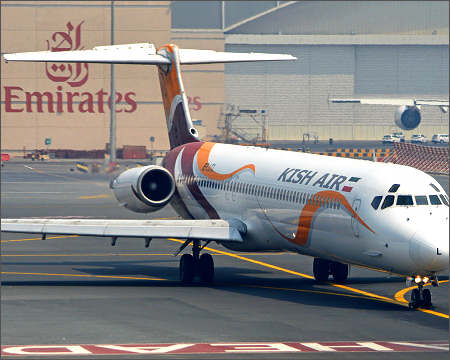
DUBAI,— The United Arab Emirates grounded every Iranian airline on Thursday, becoming the clearest sign yet that a new round of U.S. sanctions is starting to squeeze Iran’s air travel network.
The UAE’s General Civil Aviation Authority said it was suspending all flights operated by Iranian carriers until further notice.
The UAE is the busiest travel hub in the Middle East, so the move is expected to cause major disruption for Iranian passengers and cargo operators.
Iran’s semi-official Tasnim news agency said Oman, Georgia and Azerbaijan had also closed their skies to Iranian planes, along with the Iraqi capital, Baghdad.
Tasnim said officials were trying to reroute those flights through Najaf, another Iraqi city that draws large numbers of Shi’ite Muslim pilgrims.
The closures follow a warning from Washington that any company anywhere in the world doing business with Iranian airlines after September 23 could face U.S. sanctions.
The policy is meant to keep Iran’s entire civilian airline fleet grounded internationally.
Several other Gulf nations appeared to be following the same path.
A schedule board at Tehran’s Imam Khomeini Airport on Thursday showed flights to and from Afghanistan, Armenia, China, Iraq, Pakistan, Tajikistan and Turkey.
But there were no flights to or from the nearby Gulf states, which have historically been among Iran’s most important trade and travel partners.
Iranian officials have warned that enforcing a U.S.-driven air blockade could trigger a wider response. A senior Iranian official said Wednesday that any country in the region that follows the American ban could see its own airports made “unusable.”
Also Thursday, Saudi Arabia said its forces shot down six ballistic missiles launched by Yemen’s Houthi movement.
The Houthis claimed they had launched dozens of missiles and drones at targets inside Saudi Arabia. Fighting between Saudi forces and the Houthis has intensified this month, turning into one of the more active fronts in the broader Middle East conflict.
The flight bans are part of a broader shift in U.S. strategy, as the U.S. and Israeli campaign against Iran has stalled militarily for months.
Washington is now leaning harder on so-called secondary sanctions, which punish companies based in other countries for doing business with Iranian firms.
President Trump described the new approach last month as an “economic D-Day,” likening it to the World War Two invasion of Nazi-occupied France by the United States and its allies.
If the flight restrictions hold, they could deepen Iran’s isolation and add pressure to an economy already strained by a U.S. naval blockade of Iranian ports.
A retired teacher in Tehran, speaking to Reuters by text message on condition of anonymity, described the situation bluntly: life there, she said, now feels like being trapped in an open-air prison.
(With files from Reuters)
Copyright © 2026 Dubai Diplomacy. All rights reserved.
 Your support matters! Consider buying us a coffee — every bit helps keep independent news alive.
Related posts:
 Airlines suspend more flights to UAE, ME amid rising conflict
 Some travelers paid $232,000 for flights to escape Gulf countries, amid Iran conflict
 Emirates, Etihad resume limited flights to major global cities
 Why the Middle East’s “Islamic NATO” is an Illusion
 Is a Gulf NATO Really Possible?
 Chaos in skies as Dubai Emirates flight turn back mid-air
 Saudi-UAE rift widens as Emirates quits oil cartel
 Britain’s Virgin Atlantic suspends Dubai flights until 2027