Editor’s note: This article examines a hypothetical “worst-case” scenario should the Iranian regime face total collapse. There is no intelligence indicating that such a weapon has been built or deployed. The analysis is intended for security professionals and policymakers.
Halima Younis – Exclusive to Dubai Diplomacy
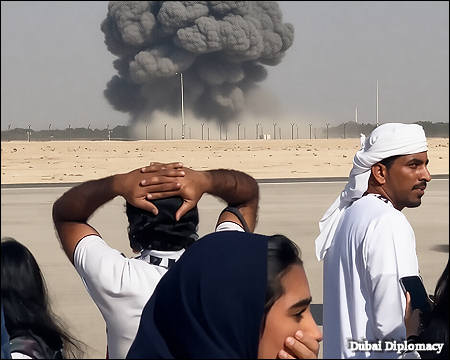
After we saw a drone strike cause a fire at a nuclear power plant in the United Arab Emirates, officials in Abu Dhabi said Sunday that the “unprovoked terrorist attack” represented a “dangerous escalation” of regional tensions.
The attack demonstrates that radiological contamination of UAE territory is not a red line for Tehran, raising the stakes for a potential dirty bomb scenario if the regime collapses.
For decades, Western and regional analysts have focused on Iran developing a nuclear weapon, requiring 90% uranium enrichment. Yet, if the Iranian regime faces total military collapse or internal revolution, a more immediate and terrifying scenario emerges: the radiological “dirty bomb.”
Unlike a nuclear weapon, a dirty bomb does not require a complex chain reaction. It is a “weapon of mass disruption,” conventional explosives wrapped in radioactive material designed to contaminate cities and infrastructure. According to expert analysis, Iran’s current stockpile of 60% enriched uranium is more than sufficient for this task.
If the regime in Tehran believes it faces an existential “end of days” scenario, strategic restraint vanishes. Iran would seek to inflict maximum damage on its neighbors. The Gulf states, particularly the United Arab Emirates (UAE), are the most vulnerable targets .
The Material Reality: 60% Enrichment is Sufficient
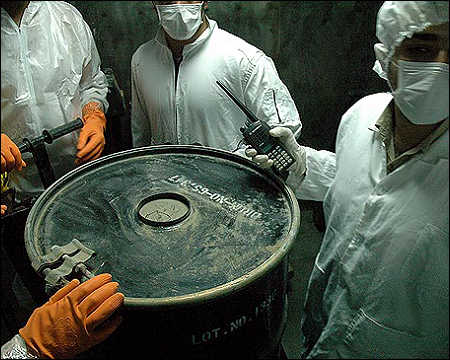
Iran does not need to be a nuclear-weapon state to build a dirty bomb. A true nuclear weapon requires approximately 25kg of uranium-235 enriched to 90%. However, a dirty bomb requires only radioactive material, and Iran has a massive stockpile of that.
According to the International Atomic Energy Agency (IAEA), as of September 2025, Iran had in its possession 440.9 kg of uranium enriched up to 60% of the explosive uranium isotope U-235 .
The IAEA defines a “significant quantity” of highly enriched uranium as containing 25 kg of U-235, meaning Iran’s stockpile could theoretically provide the fuel for nine nuclear weapons if further enriched to 90% .
According to US Special Envoy Steve Witkoff, Iranian negotiators openly acknowledged during negotiations that they possessed roughly 460 kilograms of uranium enriched to 60 percent, an amount they admitted could be converted into as many as 11 nuclear bombs.
Witkoff told Fox News that the Iranian negotiators stated this “with no shame” and appeared “proud that they had evaded all sorts of oversight protocols to get to a place where they could deliver 11 nuclear bombs” . He added that building a dirty bomb from this material would be an “easy step” for the regime.
It involves grinding highly reactive uranium into a fine powder or pellets and affixing them to a conventional high-explosive charge. When detonated, the explosion vaporizes the uranium into a radioactive cloud that settles over buildings, water supplies, and soil.
Delivery Systems: Ballistic Missiles and Drones
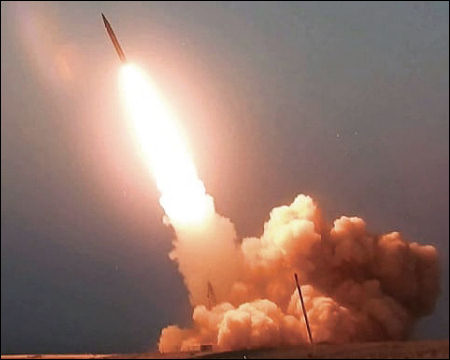
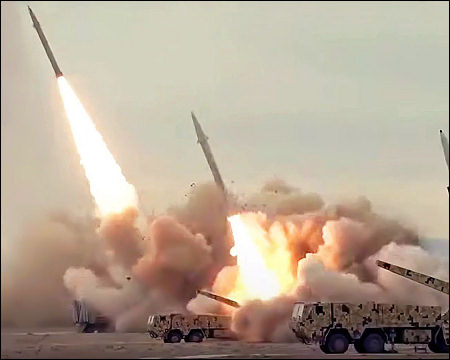
The Islamic Revolutionary Guard Corps (IRGC) has perfected the ability to hit the UAE with precision. According to the UAE Ministry of Defense, since Iranian attacks began in February 2026, the country’s air defense systems have intercepted a total of 551 ballistic missiles, 29 cruise missiles, and 2,265 drones launched from Iran .
Ballistic Missiles: The most likely delivery method is a medium-range ballistic missile (MRBM), such as the *Shahab-3* or Khorramshahr. Iran has already demonstrated the ability to strike the UAE with conventional warheads.
According to UAE defense officials, air defense systems successfully engaged eight ballistic missiles, four cruise missiles, and 36 drones in a single wave of attacks on March 31, 2026 . Substituting the high-explosive filler with a 60% enriched uranium jacket transforms a standard missile into a radiological projectile capable of contaminating a several-block radius upon impact.
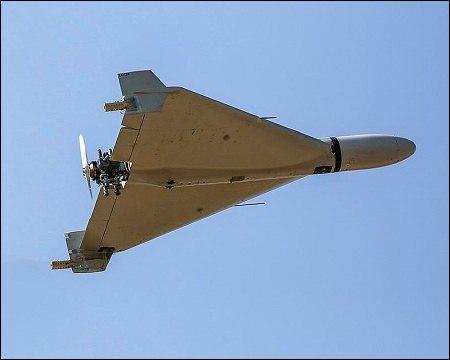
Drones: The Shahed series “one-way attack” drones offer precision and radar evasion. According to UAE security updates, drones have been repeatedly intercepted flying low over the Arabian Gulf toward targets in the UAE . Because the payload is radioactive, even a small explosive charge can effectively disperse the material.
The Targets: Turning the UAE into an Exclusion Zone
The goal of a dirty bomb is not mass casualties but to make the enemy’s land “uninhabitable.” The UAE is a desert nation that relies entirely on artificial infrastructure for survival.
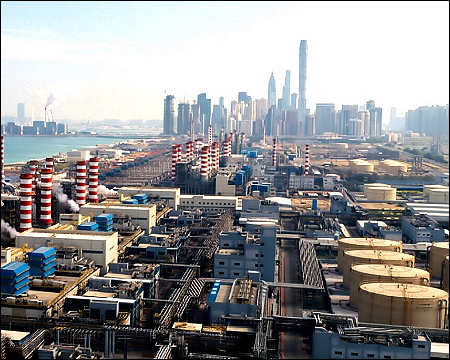
Primary Target: Desalination Plants
The UAE relies on Gulf seawater for nearly 100% of its drinking water. These plants, located in Jebel Ali and Fujairah, are massive coastal complexes. If Iran strikes a desalination plant with a 60% enriched uranium warhead, it creates a “water exclusion zone.” Radioactive fallout would contaminate intake pipes and the facility itself. Shutting down a single major desalination hub for decontamination, a process taking months or years, would cut off fresh water to millions. The panic would be immediate.
Secondary Target: Oil and Port Infrastructure
The UAE’s economy flows through its ports, including Jebel Ali and Khalifa Port, and oil storage facilities. A dirty bomb delivered by ballistic missile or drone to an oil tank farm does not just destroy the oil; it makes the oil radioactive. Insurance and shipping industries have zero tolerance for radiological contamination. An attack on Fujairah, a major oil hub just outside the Strait of Hormuz, could effectively close the port to international shipping indefinitely.
Tertiary Target: Aviation and Tourism
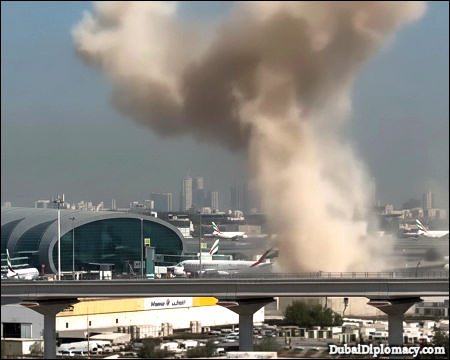
Dubai International Airport (DXB) is the world’s busiest hub for international travel. According to UAE officials, falling debris from intercepted threats has already caused injuries in southern Dubai . A drone carrying a dirty bomb that detonates on a taxiway or terminal would shatter the UAE’s brand as a safe, global crossroads. The psychological impact of a “radioactive airport” would destroy the tourism sector that drives GDP.
The Strategic Context: Why “Total Collapse” Changes the Calculus
Under normal circumstances, experts agree that using a dirty bomb would be “strategic suicide.” The traceability of the uranium, as isotopic signatures are unique, would strip Iran of plausible deniability, triggering a unified international military response.
However, the “Last Resort” scenario changes this logic. If the Iranian regime is facing total collapse, whether through internal uprising, military rout, or the death of its leadership, the calculus shifts from preserving the regime to avenging its fall.
A US military exit appears increasingly close as Trump has rejected all of Tehran’s proposals for a deal.
In this state, the IRGC may believe it has nothing left to lose. The goal would be to drag the Gulf states into the abyss alongside Tehran, hoping that a regional economic meltdown forces the US and Israel to halt their advance.
The Case of the UAE
The UAE is specifically at risk. According to Iranian statements, Tehran has accused the UAE of allowing its territory to be used by “the aggressor,” Israel and the US, to launch attacks against Iran. The UAE has repeatedly accused Iran of launching strikes, a claim Tehran has denied, though Iranian Foreign Minister Abbas Araghchi stated that “the UAE is an active partner in this aggression” .
If the regime feels it is about to be toppled, a dirty bomb against the UAE would serve a dual purpose: punishment for the UAE’s perceived role in the coalition, and blackmail to force Western powers to halt their offensive to manage the humanitarian crisis.
Conclusion
Iran does not need a nuclear weapon to hold the Gulf states hostage. With its existing stockpile of 60% enriched uranium, Tehran has the raw material for a devastating radiological weapon available today.
According to IAEA Director General Rafael Grossi, more than 200kg of 60% enriched uranium alone was stored at the Isfahan tunnel complex and is likely still there .
While such a move would spell the end of the regime’s political legitimacy, the prospect of total collapse removes the deterrent of rational analysis. The UAE’s infrastructure, specifically its desalination plants, ports, and airports, represents a “glass jaw” that Iran could shatter with a single contaminated missile or drone.
For Gulf security planners, the radiological threat may be more immediate than a nuclear detonation, even if its destructive power is far lower.
Halima Younis, political analyst.
All views expressed herein are solely those of the author and do not necessarily represent the opinions or policies of DubaiDiplomacy or its editors.
Copyright © 2026 Dubai Diplomacy. All rights reserved.
 Your support matters! Consider buying us a coffee — every bit helps keep independent news alive.
Related posts:
 UAE and the Gulf Will Never Be Safe While Iran’s Regime Survives
 The Strait of Hormuz will be closed as soon as the U.S. navy leaves
 UAE urges US and Iran to reach nuclear deal before talks
 IAEA warns UAE’s Barakah nuclear plant attack risks radioactive release
 Is a Gulf NATO Really Possible?
 Luxury brands in UAE face profit squeeze amid Iran conflict