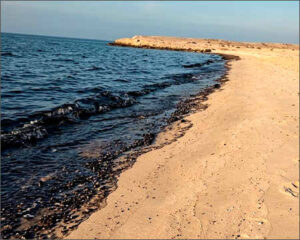
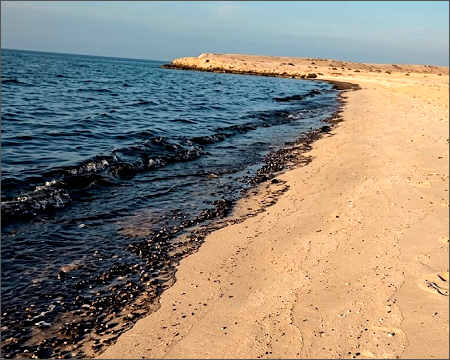
DUBAI — An expanding oil spill from a damaged tanker offshore has prompted beach closures across several northern emirates of the United Arab Emirates, as satellite images show pollution spreading toward the coastline of Umm Al Quwain.
Images captured on Oct. 24 by the European Union’s Copernicus Sentinel-2 satellites showed a large slick extending across the sea, with dark layers of oil approaching the northern emirate’s shoreline.
The UAE government said Friday that efforts were underway to contain the leak.
The Ministry of Climate Change and Environment was also conducting an assessment to determine the spill’s environmental impact. Authorities have not identified the tanker involved or disclosed what caused the incident.
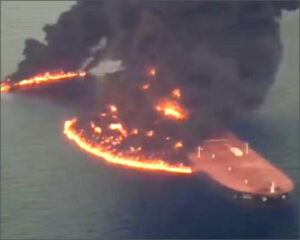
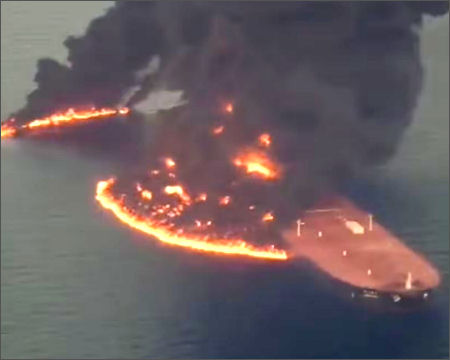
Experts told Reuters that the oil originated from a tanker named Gem No. 2. Shipping sources said the vessel was struck by an unidentified projectile last month, triggering a fire that was later extinguished.
Satellite images from the European Union’s Copernicus observation network showed the scale of the spill and its spread across nearby waters.
The incident has led authorities to restrict access to several coastal areas. The environment ministry announced Friday that beaches and coastal areas around Umm Al Quwain were temporarily closed.
In neighboring Sharjah, officials also closed Al Hamriyah Beach as a precaution while the situation was assessed.
Nidal Hilal, an engineering professor and director of New York University Abu Dhabi’s Water Research Center, told Reuters that the spill posed a serious environmental concern.
He said temporary closures were a prudent measure while authorities examined the extent of the pollution and monitored the oil’s movement.
Authorities in Ras Al Khaimah announced Saturday that all beaches in the emirate would remain closed until further notice.
The emirate is known for its beaches and luxury resorts, making the closures significant for its coastal areas.
The spill comes amid growing security risks for commercial shipping in Gulf waters since the start of the US-Israeli war with Iran.
Attacks on commercial vessels have increased concerns about maritime safety and the environmental consequences of the conflict.
Data compiled by the Washington Institute for Near East Policy shows that October has been the worst month for attacks on commercial shipping in the Strait of Hormuz and nearby waterways.
The potential environmental impact extends to the Gulf’s marine ecosystems.
The International Union for Conservation of Nature, or IUCN, says the region’s waters support more than 500 fish species, along with dolphins, marine turtles, plants and corals.
The spread of oil has raised concerns about the risks to these coastal habitats and marine life.
(With files from Reuters)
Copyright © 2026 Dubai Diplomacy. All rights reserved.
 Your support matters! Consider buying us a coffee — every bit helps keep independent news alive.
Related posts:
 UAE’s Ras Al Khaimah closes all beaches over oil spill
 ADNOC takes more aggressive oil marketing approach after OPEC exit: report
 UAE’s Fujairah halts some oil loading after Iran drone attack
 Iran launches missile and drone strikes at UAE, ministry says
 UAE, Qatar arrest hundreds over Iran attack footage: NY Times
 UAE holds 70 Brits for sharing drone strike videos, images
 Dubai to plant 20,000 trees marking Sheikh Mohammed’s 20 years
 UAE says Iran struck its oil tankers in Hormuz, sailor killed