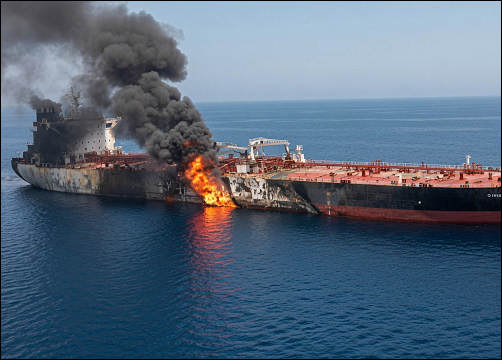
DUBAI,—One Indian sailor died and eight crew members suffered injuries after Iranian cruise missiles struck two Emirati oil tankers in the Strait of Hormuz, the United Arab Emirates Ministry of Defence announced Tuesday, marking a fresh flashpoint in the vital waterway.
Officials said the vessels, identified as the Mombasa and Al Bahiyah, came under fire while sailing through the strait’s southern corridor inside Omani territorial waters.
The crew member who died had been working aboard the Mombasa, the ministry noted.
Among the eight injured sailors, four were listed in serious condition. Six of the wounded held Indian citizenship, while the remaining two were from Ukraine, officials said.
Both tankers sustained physical damage after flames erupted onboard following the strikes. Firefighting crews later managed to extinguish the blazes, the ministry confirmed.
Emirati authorities described the assault as a “blatant attack” and warned that the UAE reserves “its full right to respond to this escalation.”
Iran’s Islamic Revolutionary Guard Corps said separately Tuesday that its forces had disabled two “offending” supertankers in the strait after the ships repeatedly disregarded warnings, shut off their navigation tracking, and tried crossing a route the Guards had labeled as mined.
The IRGC did not identify the tankers by name or clarify whether its account matched the incident described by the UAE defense ministry.
The Guards further accused Washington of “inciting vessels to use an illegal route,” cautioning that any cooperation with what it called the “aggressor enemy” would only bring further damage, delay efforts to reopen Hormuz, and trigger a worldwide energy crisis.
In a separate development, the United Kingdom Maritime Trade Operations agency reported that another tanker was struck by an unidentified projectile while sailing roughly 40 nautical miles northeast of Qalhat, Oman.
According to the vessel’s captain, the projectile hit the engine room on the starboard side, though the entire crew remained unharmed. It could not be immediately confirmed whether this incident matched the one described by UAE officials.
These latest episodes follow weeks of rising tension since fighting erupted on February 28, 2026, when American and Israeli forces launched strikes against Iranian targets.
The U.S. military conducted its third straight night of bombing raids on Iran Monday, as President Donald Trump reimposed a blockade on Iranian shipping and floated a proposal to charge a 20 percent fee for protecting traffic through Hormuz.
Iran’s senior joint military command insisted the United States had no authority over the waterway’s future and would not be permitted to interfere.
The broader conflict has destabilized the Gulf region, with Iran striking American installations across several countries and casting doubt on a preliminary U.S. Iran deal reached last month meant to reopen the strait and end hostilities.
Before February’s outbreak, close to one fifth of global oil and gas shipments passed daily through Hormuz, carrying over 15 million barrels worth at least $1.2 billion.
(With files from Reuters)
Copyright © 2026 Dubai Diplomacy. All rights reserved.
 Your support matters! Consider buying us a coffee — every bit helps keep independent news alive.
Related posts:
 UAE secretly slips oil tankers through Strait of Hormuz: Reuters
 Iran Now Sees the Strait of Hormuz as a Cash Cow
 Gulf states press Trump to continue war until Iran is fully weakened
 Could UAE Face Dirty Bomb Risk If Iran Falls?
 The Strait of Hormuz will be closed as soon as the U.S. navy leaves
 Trump says US will impose 20% charge on Hormuz strait shipments
 Iran launches missile and drone strikes at UAE, ministry says
 Drone hits UAE nuclear power plant amid Iran tensions