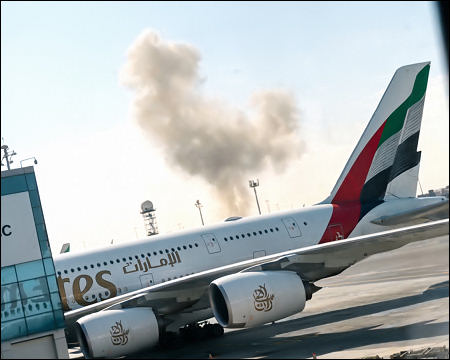
DUBAI,— Two drones fell near Dubai International Airport on Wednesday, while Bahrain moved several planes to other airports, as attacks on Gulf infrastructure continued to disrupt air travel during the 12th day of the conflict with Iran.
Dubai’s media office confirmed the two drones fell near the airport but said operations continued as normal.
Witnesses for Reuters saw no visible damage. Four people were reported injured.
The U.S.-Israel military campaign against Iran has triggered tens of thousands of flight cancellations, reroutes, and schedule changes worldwide.
Large portions of Middle Eastern airspace, including Qatar’s, remain closed due to missile and drone threats, causing the region’s aviation industry to face its worst crisis since the COVID-19 pandemic.
Dubai International Airport, the world’s busiest for international passengers, along with other regional airports, plays a central role in long-haul connections, and the disruptions have slowed the flow of global travelers.
The conflict has also affected a key oil export route, driving up jet fuel prices, increasing ticket costs on some routes, and raising concerns over broader declines in air travel. Time-sensitive cargo shipments have been particularly hard hit.
Authorities in Vietnam warned Wednesday that local airlines could face fuel shortages as early as next month because of the ripple effects from the Gulf.
Bahrain’s Civil Aviation Affairs said several Gulf Air planes without passengers, along with some cargo aircraft, were moved to alternative airports to “ensure the continuity and efficiency of air operations” during the ongoing crisis.
Flight-tracking data from FlightRadar24 showed multiple passenger planes relocating to airports in Saudi Arabia over the past day.
This incident comes after Dubai International Airport, Abu Dhabi, and Kuwait’s international airports sustained damage on the conflict’s first day.
Regional airlines including Emirates, Etihad, and Qatar Airways have restarted some flights but remain well below full capacity.
Over the weekend, UAE carriers operated more than 600 daily flights, though FlightRadar24 data showed numbers plateaued before dipping slightly on Tuesday.
Tensions in the region escalated after the United States and Israel conducted joint airstrikes against Iran on February 28, 2026, killing Iran’s supreme leader and more than 40 senior military officers in Tehran and other cities.
Iran responded with multiple waves of missile and drone attacks targeting airports, seaports, hotels, oil facilities, and residential areas in Dubai and Abu Dhabi.
Amazon said on March 2 that several of its UAE data centers were damaged in drone strikes, disrupting cloud computing services.
(With files from Reuters)
Copyright © 2026 Dubai Diplomacy. All rights reserved.
 Your support matters! Consider buying us a coffee — every bit helps keep independent news alive.
Related posts:
 Iran hits luxury Dubai hotel in retaliatory strikes across Arab region
 Firms exit Dubai financial hub over rising Iran threats
 Iranian drone hits Dubai airport again, flights suspended
 Luxury brands shut UAE, Middle East stores amid Middle East conflict
 UAE property market faces test after Iran attacks; foreign buyers crucial
 Some travelers paid $232,000 for flights to escape Gulf countries, amid Iran conflict
 Dubai ruler issues law on building quality and safety, UAE
 Amazon’s UAE data center damaged in Iran drone attack