DUBAI,— Iran issued a warning last week describing submarine cables in the Strait of Hormuz as a weak point for the region’s digital economy, raising concern about possible attacks on critical infrastructure, Reuters reported.
The narrow waterway is already a key route for global oil shipments and also plays a central role in global data transmission.
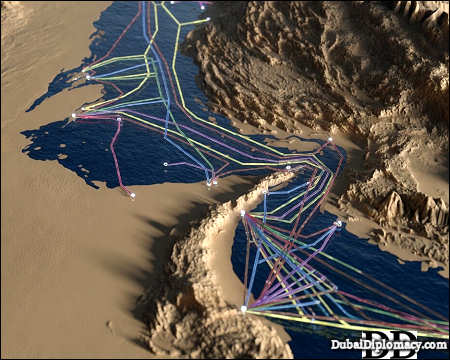
Multiple fiber optic cables run along the seabed, linking countries in India and Southeast Asia to Europe through Gulf states and Egypt.
Subsea cables are fiber optic or electrical lines placed on the ocean floor to carry data and power.
They handle about 99% of global internet traffic, according to the International Telecommunication Union, a United Nations agency focused on digital technologies.
These cables support telecommunications, electricity transfers between countries, cloud services, and online communications.
Any damage can slow internet speeds or cause outages, disrupting e-commerce and delaying financial transactions, which can lead to broader economic effects, geopolitical and energy analyst Masha Kotkin said.
Countries in the Gulf, especially the United Arab Emirates and Saudi Arabia, have invested heavily in artificial intelligence and digital infrastructure as part of efforts to reduce reliance on oil revenues.
Both countries have created national AI companies that depend on fast data transfers enabled by undersea cables.
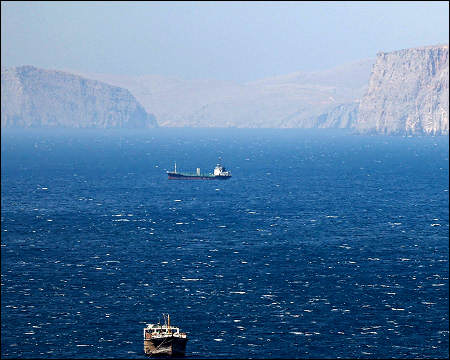
Several major cable systems pass through the Strait of Hormuz. These include the Asia-Africa-Europe 1 cable linking Southeast Asia to Europe through Egypt, with landing points in the UAE, Oman, Qatar, and Saudi Arabia.
The FALCON network connects India and Sri Lanka to Gulf countries, Sudan, and Egypt.
The Gulf Bridge International Cable System links Gulf states, including Iran. Additional systems are under development, including one led by Qatar-based Ooredoo.
Despite growth in the total length of submarine cables between 2014 and 2025, the number of faults has remained stable at about 150 to 200 incidents each year, according to the International Cable Protection Committee.
Experts say 70% to 80% of these incidents result from human activity such as fishing or ship anchors. State-backed sabotage remains a risk but is less common.
Natural hazards also pose threats, including underwater currents, earthquakes, volcanic activity, and typhoons, said Alan Mauldin, research director at telecom research firm TeleGeography.
To reduce risks, cables are buried, reinforced, and routed through safer areas.
The ongoing Iran war, now approaching two months, has caused disruption to global energy supplies and regional infrastructure.
This includes reported damage to Amazon Web Services data centers in Bahrain and the UAE. So far, subsea cables have not been directly affected.
However, indirect risks remain. Damaged or drifting ships may drag anchors across the seabed and strike cables.
Kotkin said the likelihood of accidental damage increases during active military operations and grows as conflict continues.
A similar incident occurred in 2024, when a commercial vessel targeted by Iran-aligned Houthi forces drifted in the Red Sea and cut cables with its anchor.
The extent of any disruption to connectivity in Gulf countries would depend on how much operators rely on specific cables and whether alternative routes are available, TeleGeography said.
Repairing damaged cables in conflict zones presents additional challenges.
While the repair process itself is relatively straightforward, decisions by ship operators and insurers may be influenced by risks such as ongoing fighting or the presence of naval mines.
Access permits to enter territorial waters can also delay repairs. Mauldin said obtaining permission is often one of the most time-consuming aspects of fixing cables.
After conflicts end, companies must survey the seabed again to identify safe routes and avoid obstacles such as sunken vessels.
Experts say land-based connections provide some backup if cables fail, but satellite systems cannot fully replace them. Satellites have limited capacity and higher costs, and they still depend on ground infrastructure.
Mauldin said satellite networks are better suited for mobile uses such as aircraft and ships. Kotkin added that low-Earth-orbit systems like Starlink are not yet capable of serving large populations at scale.
In February 2026, a joint group from Iraq and the United Arab Emirates was preparing a $700 million project combining subsea and land-based infrastructure to connect the UAE with Turkey through Iraq.
(With files from Reuters)
Copyright © 2026 Dubai Diplomacy. All rights reserved.
 Your support matters! Consider buying us a coffee — every bit helps keep independent news alive.
Related posts:
 UAE-Iraqi consortium plans $700 million WorldLink data cable on AI boom
 Some travelers paid $232,000 for flights to escape Gulf countries, amid Iran conflict
 Egypt, Qatar sign deal to expand LNG trade, Egypt says
 UAE issues new federal law on child digital safety
 Gulf states say ending Iran war not enough, degrade its capabilities
 Gulf states press Trump to continue war until Iran is fully weakened
 UAE ports key to Gulf trade lifeline
 Saudi-UAE rift widens as Emirates quits oil cartel