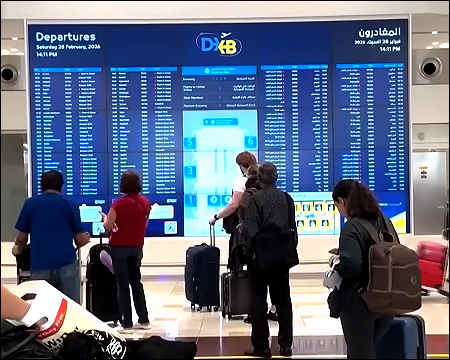
DUBAI,— Major airports in Dubai and Abu Dhabi in the UAE were shut down, and thousands of passengers were left stranded across the Middle East after United States and Israel strikes on Iran triggered widespread airspace closures.
Dubai International Airport, the largest airport in the United Arab Emirates and one of the busiest in the world for international travel, halted operations after what officials described as a blatant attack involving Iranian ballistic missiles.
Authorities at Dubai International Airport said four people were injured. At Zayed International Airport in Abu Dhabi, officials reported one person was killed and seven others were injured in what they described as a drone strike.
Strikes were also reported at Kuwait International Airport.
The United Arab Emirates government announced what it called a temporary and partial closure of its airspace. Flight tracking service Flightradar24 said there was no flight activity over the country following the announcement.
Airports in Dubai, Abu Dhabi, Doha and Manama were among those that closed. More than 3,400 flights were canceled Sunday across seven airports in the Middle East, according to Flightradar24.
Emirates Airlines suspended all flights to and from Dubai until at least Sunday afternoon. Qatar Airways said Doha’s airport would remain closed until at least Monday morning.
Countries including Israel, Qatar, Syria, Iran, Iraq, Kuwait and Bahrain closed their airspace. Oman’s Muscat International Airport also shut down, while flights were restricted over the United Arab Emirates.
The shutdown of major transit hubs in Dubai, Abu Dhabi and Doha disrupted global travel. Aviation analytics firm Cirium said around 90,000 passengers per day typically pass through those three hubs on Emirates, Qatar Airways and Etihad Airways alone.
The total number of affected travelers worldwide is difficult to calculate, Cirium said.
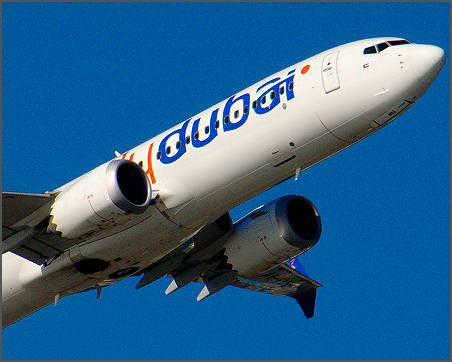
Airlines across the region canceled hundreds of flights. Cirium reported that at least 850 flights were canceled Saturday by Middle Eastern carriers, including Emirates, Flydubai, Gulf Air, Qatar Airways and Kuwait Airways.
Aircraft heading to cities such as Tel Aviv and Dubai were diverted to other airports in Europe or returned to their departure points. Some flights were rerouted to Athens, Istanbul or Rome.
Henry Harteveldt, president of Atmosphere Research Group, said travelers should prepare for continuing disruption.
“For travelers, there’s no way to sugarcoat this,” Harteveldt said. “You should prepare for delays or cancellations for the next few days as these attacks evolve and hopefully end.”
Airlines crossing the Middle East are expected to reroute flights, with many heading south over Saudi Arabia. Such changes will increase flight times and fuel use, raising operating costs. Ticket prices could rise if the conflict continues.
The extra traffic may also increase pressure on Saudi air traffic controllers, who may need to slow traffic to maintain safety. Countries that closed their airspace will lose overflight fees paid by airlines.
Mike McCormick, a former Federal Aviation Administration air traffic control executive and now a professor at Embry Riddle Aeronautical University, said some countries may reopen parts of their airspace within days if military officials provide clear information about flight operations and missile risks.
(With files from AP)
Copyright © 2026 Dubai Diplomacy. All rights reserved.
 Your support matters! Consider buying us a coffee — every bit helps keep independent news alive.
Related posts:
 Some travelers paid $232,000 for flights to escape Gulf countries, amid Iran conflict
 Emirates, Etihad resume limited flights to major global cities
 Luxury brands shut UAE, Middle East stores amid Middle East conflict
 Dubai aviation hub’s market faces test amid Middle East conflict
 Etihad Airways reports 22.4 million passengers in 2025
 Thousands struggle to leave Gulf countries amid Iran conflict
 Dubai International Airport reports record 95.2 million passengers in 2025
 Dubai airport, Burj al Arab hotel hit in Iran missile strike