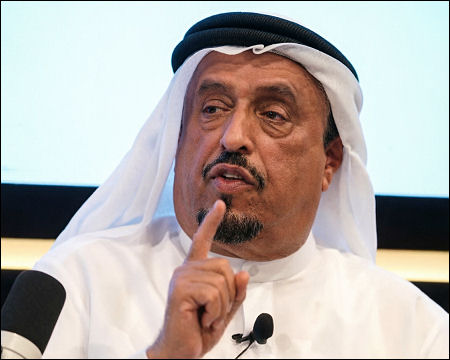
Dubai’s Security Chief Breaks the Taboo: Israel Over Arab Allies
DUBAI,— Dubai’s Deputy Police Chief Dhahi Khalfan Tamim ignited a firestorm of controversy across the Arab world this week after publicly urging Gulf states to deepen their cooperation with Israel, dismissing ties with fellow Arab nations as “no good” by comparison.
Khalfan wrote on X “Shame on the Gulf countries for remaining in an organization that calls itself an Arab League while it lacks Arab sentiment and sympathizes with the Persians!!”
“O people of the Arab Gulf… trust in cooperation with Israel… a piece of advice… there is no good in the countries of the region at all.” he added.
The remarks, coming from one of the UAE’s most prominent security figures, have reignited a simmering debate about where the Emirates truly stands in the region, and at whose expense.
Who Is Dhahi Khalfan Tamim?
Khalfan is no ordinary official. As Dubai’s Deputy Police Chief, he commands significant institutional authority and boasts millions of followers on social media, making him one of the UAE’s most influential public voices. What makes his latest comments especially striking is how dramatically they contrast with his own recent record.
As recently as 2024, Khalfan publicly told his followers that “The Arabs really wanted peace, but the leaders of Israel do not deserve respect”, a position that now appears to have reversed entirely. His latest pivot toward openly endorsing closer Israeli alignment has left many observers questioning whether his views reflect a personal shift, or a quiet signal from within the Emirati establishment.
What He Said — and Why It Landed So Hard
Khalfan argued that Arab alliances offer the Gulf states little of strategic value, and that Israel and the West represent more dependable partners. Regional commentators broadly condemned the stance as strategically flawed, accusing him of undermining Arab unity, according to Haaretz.
The remarks stoked particular anger because they came unprompted, in a public forum, at a time when Palestinian civilian casualties in Gaza remain a raw and deeply felt issue across the Arab world.
The backlash was swift. Critics accused him of normalizing Israeli foreign policy at a moment when many Arab publics have grown more hostile to Israel, not less. For Arab audiences watching the war in Gaza unfold on their screens, Khalfan’s words felt less like realpolitik and more like a betrayal.
The Abraham Accords — Fraying at the Edges
To understand the controversy, it helps to understand how the UAE’s relationship with Israel has evolved since the two countries normalized ties in 2020 under the Abraham Accords. What was once celebrated in Abu Dhabi as a bold diplomatic breakthrough has become increasingly difficult to defend publicly.
Public support for the Abraham Accords had already begun to diminish, both within the UAE and across the Gulf, even before Israel launched its retaliation military campaign against Hamas in Gaza in October 2023. Prominent Emirati figures who once championed normalization have since offered critical reassessments.
The UAE government has responded to this shift carefully. Abu Dhabi has adopted sharper rhetoric condemning Israel’s conduct, more consistently emphasized Palestinian statehood as essential for lasting peace, and moved toward conducting ties with Israel in a more discreet manner. Middle East Council on Global Affairs Khalfan’s blunt public advocacy for deeper alignment with Israel cuts against that careful recalibration, which may explain why his comments drew such sharp attention.
Iran: The Factor Pushing Gulf States Toward Israel
Beneath the controversy lies a strategic reality that helps explain why some Emirati officials continue to see Israel as an indispensable partner: the threat from Iran.

Emirati Minister of State for Foreign Affairs Anwar Gargash made this calculus explicit, stating that Iran’s attacks on Gulf states are pushing them closer to both Israel and the United States: “Iran’s full-throttle attack on the Gulf states will actually strengthen the Israeli role in the Gulf, will not diminish it.” He noted that the UAE has intercepted 327 Iranian ballistic missiles, 15 cruise missiles, and 1,699 drones since the start of the conflict.
For Gulf security planners, these are not abstract numbers. The shared threat perception with Israel, particularly around Iranian missile capabilities and proxy networks, remains a powerful driver of quiet cooperation, regardless of the public mood.
The Saudi–UAE Fault Line
Adding another layer of complexity is the deepening rivalry between the UAE and Saudi Arabia, which has increasingly played out through their respective positions on Israel. After Yemen became a major flashpoint in tensions between Riyadh and Abu Dhabi in late 2025 and early 2026, Somalia and Somaliland emerged as a further arena of strategic competition, with friction visible across multiple regional fault lines. Many Saudis, and people across the Arab region more broadly, criticize the UAE for being too willing to accommodate the Israeli government.
The Saudi pushback has not been subtle. A Saudi strategic influence campaign has branded Abu Dhabi with labels like “Israeli Trojan horse” and “an Israeli project wearing an Arab cloak,” aimed at undermining the legitimacy of a state that chose the Abraham Accords. Khalfan’s remarks, whether intentional or not, hand Riyadh more ammunition for that narrative.
The Strategic Case for UAE-Israel Defense Cooperation

Analysts who support closer UAE-Israel ties point to a compelling strategic rationale that goes beyond politics. Israel consistently ranks as one of the most functional democracies in the Middle East, regularly assessed by international indices as a stable, rule-of-law state, a factor that proponents argue makes it a more predictable and reliable long-term partner than many of its neighbors.
Israel’s intelligence agency, Mossad, carries a global reputation widely regarded among security experts as among the most capable in the world, with a long track record of operating effectively in precisely the kind of threat environments, Iranian proxies, missile networks, cyber warfare, that keep Gulf security planners up at night.
Israel is also a world-leading defense manufacturer, home to companies producing cutting-edge missile defense systems, drone technology, cybersecurity tools, and precision weapons that are exported to dozens of countries.
Its Iron Dome and Arrow missile defense systems, battle-tested against real-world attacks, are exactly the kind of capabilities the UAE has demonstrated it urgently needs, given the hundreds of Iranian ballistic missiles and drones it has had to intercept in recent years.
For analysts making the hard-nosed security argument, deeper UAE-Israel defense cooperation is not ideological, it is simply practical. A partnership with one of the world’s most technologically advanced militaries, backed by a world-class intelligence apparatus and a proven defense industry, could offer the UAE a significant and tangible upgrade to its defensive posture at a moment when the threats it faces are anything but hypothetical.
(With files from Haaretz | Arab Center Washington DC | Middle East regional reporting | Agencies)
Copyright © 2026 Dubai Diplomacy. All rights reserved.
Is a Gulf NATO Really Possible?
Rich, Armed, and Alone: Why Gulf States Cannot Protect Each Other Halima Younis – Exclusive to Dubai Diplomacy The Gap Between Aspiration…
 Your support matters! Consider buying us a coffee — every bit helps keep independent news alive.
Related posts:
 Saudi-UAE rift widens as Emirates quits oil cartel
 Is a Gulf NATO Really Possible?
 Israel deployed “Iron Dome” in UAE during Iran war: reports
 Israel’s Netanyahu calls UAE president, condemns Iran attack: wam
 Dubai Takes Your Money, Then Your Freedom: British family case
 UAE considers joining US effort to secure Strait of Hormuz: official
 UAE, South Korea sign $35 billion defense cooperation MOU
 Gulf states say ending Iran war not enough, degrade its capabilities